
A Qualitative Ecosystem-based Assessment of Marsh Clam Sonteul Fishery in the Seomjin River, Korea
Abstract
The Seomjin River traditional Sonteul fishery system for marsh clams (jaecheop) plays a key role in organically connecting the lifestyle of local residents, fishery resources, and the natural ecosystem in the estuary area. Its conservation value has been recognized, leading to its designation as a Nationally Important Fishery Heritage and its inscription as a Globally Important Agricultural Heritage System (GIAHS), thereby gaining international recognition for its heritage value. This study applied the qualitative Tier 2 approach of the Integrated Fisheries Risk Assessment Method for Ecosystems (IFRAME) to evaluate the resilience and sustainability of the Seomjin River marsh clam sonteul fishery system. Indicators related to four management objectives -sustainability of fishery resources, biodiversity, habitat conservation, and socio-economic benefits- were analyzed. The Fishery Risk Index (FRI) of the clam fishery system was found to be located in the safe “green zone”, indicating that the fishery is being managed at a relatively appropriate and safe level. However, problems such as declining income due to reduced production caused by the decrease in clam resources were also identified. Therefore, to ensure sustainable resource use and ecosystem conservation management, dynamic conservation measures are required. Four categories of dynamic conservation strategies for the Seomjin River marsh clam sonteul fishery were proposed. To manage the fishery and its ecosystem more effectively, it is necessary to introduce an ecosystem-based fisheries management system and establish a regular monitoring framework for quantitative assessment.
Keywords:
Sonteul (hand net) fishery, Marsh clam, IFRAME, Sustainable management, Global important Agriculture heritage systemI. Introduction
The basin of the Seomjin River, where it meets the South Sea, has long been renowned for their traditional method of harvesting freshwater marsh clam known as jaechup. This practice, a form of artisanal fishing, involves manually collecting clams from the riverbed using hands or simple tools such as a garaeng-i (a rake-like device), a method referred to as Sonteul-eo-eop([Fig. 1]). Historically, people used only their hands or small hoes to dig through the shallow waters to gather clams.
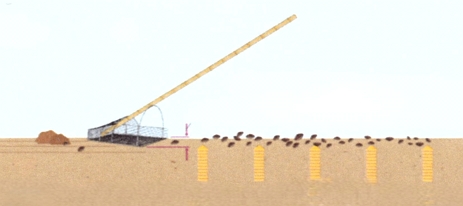
The unique knowledge system for the use of garaeng-i(hand net).
The dominant species in the Seomjin River basin is marsh clam (Corbicula japonica) a small bivalve mollusk belonging to the phylum Mollusca, class Bivalvia, order Veneroida, and family Corbiculidae. It typically inhabits sandy-muddy substrates in brackish water zones. In Korea, this species is referred to interchangeably as gisoo-jaechup (brackish water clam) and ilbon-jaechup (Japanese clam). However, authoritative sources such as The Korean Society of Systematic Zoology (1997) and the Malacological Society of Korea (2016) officially designate it as Japanese clam.
Rich in protein, vitamins, calcium, phosphorus, and iron, marsh clam (jaechup) is especially valued for its high content of essential amino acids like methionine and taurine, making it a highly prized resource both nutritionally and commercially.
In the past, jaechup (marsh clams) were widely distributed across Korea’s clear rivers and streams. However, due to changes in estuarine water quality, habitat degradation, and pollution, they have largely disappeared from most waterways. The Seomjin River basin, particularly in Hadong (Gyeongsangnam-do) and Gwangyang (Jeollanam-do), remains an exception. As a Grade 1 natural ecosystem zone, it maintains high water quality and optimal salinity levels, providing a suitable habitat for marsh clams. Consequently, this region accounts for over 70% of Korea’s total jaechup production (Hadonggun·Gwangyangsi, 2022).
The Sonteul (hand net) fishery for marsh clams in the Seomjin River plays a vital role in connecting local livelihoods, fisheries resources, and the natural ecosystem. Recognizing its cultural and ecological value, this traditional fishery system was designated as a National Important Fishery Heritage in 2018 under the title “Hand Net Fishery for Marsh Clams in Hadong and Gwangyang, Seomjin River.” In 2023, it gained international recognition by being listed as a Globally Important Agricultural Heritage System (GIAHS) under the name “The Sonteul (hand net) Fishery System for Gathering Marsh Clam in Seomjingang River Estuary” (Kim et al., 2024). This designation offers a unique opportunity to showcase Korea’s traditional fishing practices to the world.
However, the fishery now faces growing threats: rising salinity in the basin, environmental changes, a declining and aging fishing population, overharvesting of juvenile clams, and ecosystem degradation —all of which contribute to reduced clam resources and declining income for local fishers.
Previous studies on jaechup (marsh clams) in the Seomjin River have focused on topics such as reproductive cycles and estimations of harvestable biomass (Lee et al., 2012), as well as distribution patterns along salinity gradients, age structure, and growth dynamics (Lee et al., 2017).
The objective of this study is to evaluate the sustainable management and operational efficiency of the Sontul (hand net) fishery system for marsh clams in the Seomjin River. The ecosystem-based fishery assessment model employed in this research, which has Tier 1 quantitative and Tier 2 qualitative approaches(Zhang et al., 2009, 2011), evaluates the fishery system based on four key goals: sustainability of fishery resources, biodiversity, habitat quality, and socio-economic benefits. This model enables a comprehensive assessment of the current status of the fishery and provides guidance for future management strategies.
Accordingly, this study applies a qualitative Tire 2 approach within the ecosystem-based fishery assessment framework to evaluate the resilience and sustainability of the Seomjin River Sontul fishery system. Through this analysis, the study aims to propose dynamic conservation strategies for the long-term viability of traditional marsh clam harvesting in the region.
Ⅱ. Methods
To analyze the sustainable management and operational efficiency of the Sonteul (hand net) fishery system for marsh clams in the Seomjin River, this study employed the Integrated Fisheries Risk Assessment Method for Ecosystem (IFRAME) model (Zhang et al., 2009, 2011). IFRAME is one of two practical assessment methodologies recommended by the United Nations (UN, 2021) and has been widely applied in various marine and coastal regions as a tool for ecosystem-based fisheries assessment (Alsolami et al., 2020; Tirtadanu et al., 2024).
This methodology has also been utilized in the assessment of other Globally Important Agricultural Heritage Systems (GIAHS), including the jukbangryeom (bamboo weir) fishery (Kang and Zhang, 2023) and the haenyeo (female divers) fishery of Jeju Island (Zhang and Ryu, 2026).
As illustrated in [Fig. 2], the four goals and indicators defined by Zhang and Ryu (2026) within the IFRAME model show a clear and close alignment with the five selection criteria established by the GIAHS framework. This correspondence underscores the relevance and applicability of IFRAME in evaluating traditional and heritage-based fishery systems within an ecosystem-based management context.
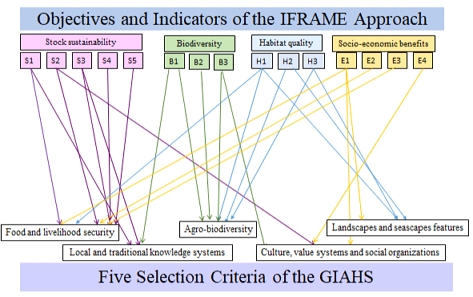
Relationship between the indicators of four objectives of the IFRAME approach and the five GIAHS (Globally Important Agricultural Heritage Systems) selection criteria. S1 refers to stock status, S2, fishing intensity, S3, size at first capture, S4, reproductive potential, S5, stock recovery, B1, species diversity, B2, bycatch, B3, discards, H1, habitat damage, H2, habitat conservation, H3, habitat restoration, E1, maintenance of livelihoods, E2, job security, E3, workplace safety, and E4, community stability.
[Fig. 3] illustrates the conceptual structure of the IFRAME model. This framework accounts for the degradation of natural ecosystems resulting from increasing anthropogenic pressures. It systematically evaluates the risk levels associated with relevant ecological indicators and recommends appropriate management actions aimed at ecosystem recovery.
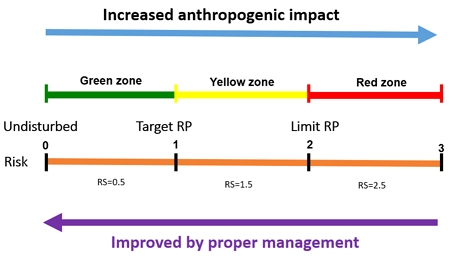
Reference point(RP) and risks of Tier 2 IFRAME.
The IFRAME model focuses on four core objectives of ecosystem-based fisheries management: (1) sustainability of fishery resources, (2) maintenance of biodiversity within fishing grounds, (3) conservation of habitats for target species, and (4) provision of socio-economic benefits. Based on these objectives, specific evaluation indicators were selected for each category, with corresponding assessment criteria and relative weights assigned to reflect their importance (<Table 1>).

Indicators and references of indicator for four objectives in the Tier 2 IFRAME approach
The sustainability assessment of the Sonteul (hand net) fishery for marsh clams in the Seomjin River was conducted using five indicators: stock status, fishing intensity, size at first capture, reproductive potential, and resource recovery. The relative importance scores assigned to these indicators were 3, 2, 1, 1, and 1, respectively. Notably, the resource recovery indicator is evaluated only in cases where overfishing has occurred.
The biodiversity assessment of the fishing grounds was based on three indicators: species diversity of catch, level of bycatch, and discard rate. Each of these indicators was assigned an equal importance score of 1.
Habitat quality was assessed using three indicators: habitat damage, habitat conservation efforts, and habitat restoration activities. Each indicator was assigned an equal importance score of 1. The habitat restoration indicator was evaluated only in cases where habitat damage had occurred.
Socio-economic benefits were evaluated based on four indicators: maintenance of livelihood, job security, workplace safety and community stability. The respective importance scores for these indicators were set at 3, 2, 1, and 1.
In total, 15 indicators were selected for assessment. Risk scores were estimated by applying the reference points presented in Zhang and Ryu (2025). Risk score was categorized into three levels: “Better than target” was classified as low risk with a score of 0.5; “Between target and limit” was considered medium risk with a score of 1.5; and “Beyond limit” was assessed as high risk with a score of 2.5, as shown in the <Appendix Table>.
Based on the estimated risk scores, the Objective Risk Index (ORI) for each management goal and the overall Fishery Risk Index (FRI) were calculated using the following formulas:
| (1) |
In the above formulas, RSi represents the risk score of indicator i, Wi denotes the relative importance (weight) of indicator i, and n is the total number of indicators. The Fishery Risk Index (FRI) was calculated according to Equation (2), as described above.
| (2) |
In this context, λ’s denotes the weight assigned to each management objective, and ORIj represents the respective Objective Risk Indices for stock sustainability, biodiversity, habitat quality, and socio-economic benefits. The sum of the four weights equals 1.0, and these values were derived from expert consultation, taking into account ecological and fisheries-related factors.
For this study, the objective weights (𝜆) were adopted from Zhang and Ryu(2025), as follows: stock sustainability (λS=0.4), biodiversity (λB=0.2), habitat quality (λH=0.1), and socio-economic benefits (λE=0.3).
The data and information used in this study were sourced from existing literature, including books, academic papers, and technical reports, and were supplemented through field investigations.
Ⅲ. Results
The management and operational status of the Sonteul (hand net) fishery for marsh clams in the Seomjin River was assessed using the Tier 2 qualitative ecosystem-based fisheries evaluation model, IFRAME. Risk scores for indicators under four management objectives, along with the Objective Risk Index (ORI) and the overall Fishery Risk Index (FRI), were estimated.
1. Indicator Risk Scores
The sustainability of the Seomjin River Sonteul fishery was evaluated based on five indicators. The first indicator, stock status, was assessed through a five-year trend analysis of catch per unit effort (CPUE). As shown in <Table 2>, CPUE has gradually declined. However, CPUE data continue to be collected through ongoing monitoring of catch and fishing effort, providing a reliable basis for evaluating stock status. Additionally, recent seed release programs have contributed to increased production (Gyeongnamilbo, 2022). The implementation of selective fishing gear and the establishment of a resource management system further support conservation efforts.
Annual catch, number of fishers and annual production of marsh clam in the hand net clam fishery system
Reflecting these conditions, the stock status indicator was classified as “Between target and limit” according to the <Appendix Table>, corresponding to a medium risk level. The estimated risk score for this indicator was 1.5 (<Table 3>).
Estimated risks for indicators of the Tier 2 IFRAME approach for the Sonteul Fishery System in Seomjin River basin
The second indicator, fishing intensity, was evaluated to be inadequate stock assessments. However, precautionary measures have been voluntarily adopted by local fishers, including production controls. Accordingly, this indicator corresponds to the “Between target and limit” category in the <Appendix Table>, indicating a medium risk level. The estimated risk score was 1.5 (<Table 3>).
The third indicator, size at first capture, is regulated under the Inland Water Fisheries Act, which sets a minimum legal harvest size for marsh clams at 1.2cm. Since this threshold is greater than the species’ maturation size(Gwak et al., 2000). the indicator falls under the “Better than target” category in the <Appendix Table>, representing a low risk level. The estimated risk score was 0.5 (<Table 3>).
The fourth indicator, reproductive potential, was assessed based on fishers’ voluntary restrictions during the spawning season (July∼August), which are influenced by weather conditions. This practice aligns with the “Between target and limit” category, resulting in a medium risk level and an estimated risk score of 1.5 (<Table 3>).
The fifth indicator, stock recovery, was excluded from evaluation as the current stock is not considered overexploited.
The first indicator, species diversity, was evaluated by examining changes in the composition of catch species. No significant shifts were observed, and the use of traditional, environmentally friendly garaeng-i gear, along with government initiatives such as coastal ranching projects, has contributed to maintaining biodiversity. However, some species shifts attributable to climate change were detected. Accordingly, this indicator was classified as “Between target and limit” in the <Appendix Table>, indicating a medium risk level, with an estimated risk score of 1.5 (<Table 3>).
The second indicator, bycatch, was assessed based on the enforcement of the Inland Water Fisheries Act, which prohibits the harvest of immature marsh clams smaller than 1.2cm. The selective nature of the garaeng-i gear further supports targeted harvesting. This indicator corresponds to the “Better than target” category, indicating a low risk level, with an estimated risk score of 0.5 (<Table 3>).
The third indicator, discards, was evaluated based on current measures aimed at preventing the disposal of undersized clams. These efforts align with the “Better than target” category, resulting in a low risk level and an estimated risk score of 0.5 (<Table 3>).
The first indicator, habitat damage, was assessed by examining the environmental impact of the garaeng-i gear. The gear was found to have minimal negative effects and may even enhance ecological conditions by promoting underwater oxygen circulation. Gear loss is rare, and traditional fishing practices continue to preserve the integrity of the ecosystem. Therefore, this indicator was classified as “Better than target,” indicating a low risk level, with an estimated risk score of 0.5 (<Table 3>).
The second indicator, habitat conservation, was evaluated in light of recent environmental changes. These include reduced discharge from upstream dams, agricultural and industrial water withdrawals, and climate change-induced flow reductions, as well as saltwater intrusion leading to increased salinity (marine influence), which has caused shifts in clam habitat distribution. Despite these pressures, the Sonteul fishery does not generate fishery-related waste and is fundamentally oriented toward ecological preservation. In addition, various habitat conservation initiatives -such as the installation of scientific purification facilities and the expansion of eco-friendly agricultural zones to block pollution sources- are actively being implemented. Accordingly, this indicator was classified as “Better than target” in the <Appendix Table>, indicating a low risk level, with an estimated risk score of 0.5 (<Table 3>).
The third indicator, habitat restoration, was excluded from evaluation as the current habitat is not considered degraded.
The first indicator, maintenance of livelihood, was evaluated based on income data. Production value of marsh clams is actively monitored, providing a basis for assessing income levels. Although production volume has shown a declining trend (<Table 2>), the added value of marsh clam harvesting -linked to annual fisher income- has been enhanced through various livelihood support initiatives, including promotional videos, brochures, souvenir production, and local festivals. Accordingly, this indicator was classified as “Between target and limit” in the <Appendix Table>, indicating a medium risk level, with an estimated risk score of 1.5 (<Table 3>).
The second indicator, job security, was assessed based on the increasing number of fishers (<Table 2>). Although aging remains a concern, efforts to support heritage-based fishing activities and secure funding for programs such as the Marsh Clam School (Hadonggun·Gwangyangsi, 2023) have facilitated the recruitment of new participants across a wide age range from their 20s to their 90s contributing to occupational stability. This indicator was classified as “Better than target,” indicating a low risk level, with an estimated risk score of 0.5 (<Table 3>).
The third indicator, workplace safety, reflects the inherently low-risk nature of the fishery. Fishing activities are voluntarily suspended during flood seasons to ensure safety. Therefore, this indicator was classified as “Better than target,” indicating a low risk level, with an estimated risk score of 0.5 (<Table 3>).
The fourth indicator, community stability, was evaluated based on the preservation of traditional knowledge and community-centered values. The fishery system continues to operate on principles of coexistence between humans and the natural ecosystem. Accordingly, this indicator was classified as “Better than target,” indicating a low risk level, with an estimated risk score of 0.5 (<Table 3>).
2. Objective Risk Index (ORI) and Fishery Risk Index (FRI)
The Objective Risk Indices (ORI) for the Sonteul (hand net) fishery system targeting marsh clams in the Seomjin River were calculated for each of the four ecosystem-based management goals, as presented in <Table 3>. The corresponding risk zones are illustrated in [Fig. 4].
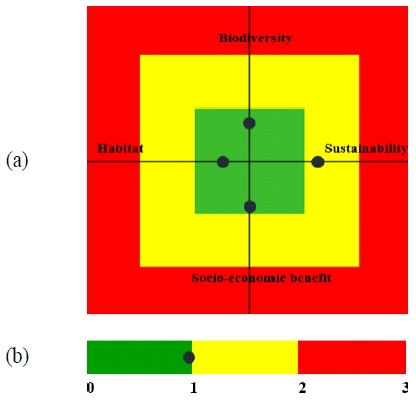
Risk diagrams (a) four ORIs and (b) FRI for the Sonteul marsh clam fishery using IFRAME approach.
The sustainability risk index (ORIS) was 1.21, placing it in the yellow zone, while the biodiversity risk index (ORIB) was 0.83, in the green zone. The habitat risk index (ORIH) was 0.50, also in the green zone, and the socio-economic benefit risk index (ORIE) was 0.93, in the green zone as well ([Fig. 4] (a)). Therefore, the hand-harvesting fishery for marsh clams in the Seomjin River is not being satisfactorily managed in terms of sustainability goals, whereas the goals related to biodiversity conservation, habitat preservation, and socio-economic benefits are being relatively effectively managed.
The overall Fishery Risk Index (FRI) was calculated as 0.98 by applying the objective-specific weights (λ) proposed by Zhang and Ryu(2025): sustainability (λS = 0.4), biodiversity (λB = 0.2), habitat (λH = 0.1), and socio-economic benefits (λE = 0.3) (<Table 3>). The FRI falls within the safe green zone, indicating that the fishery ecosystem of the hand-harvesting marsh clam fishery in the Seomjin River is in good condition ([Fig. 4] (b)). Being in the green zone means the fishery is being managed at a safe level, maintaining a high degree of resilience and sustainability.
Furthermore, it has been confirmed that the concept of ITLK (Indigenous, Traditional Owner, and Local Knowledge), which has recently been emphasized in ecosystem-based fisheries management (Evans et al., 2024), is being practically applied to the hand-harvesting marsh clam fishery in the Seomjin River.
Ⅳ. Discussion and Conclusion
The hand-harvesting marsh clam fishery system in the Seomjin River has not been satisfactorily managed in terms of the sustainability goals for fishery resources. However, it has been evaluated as relatively effective in managing the objectives related to biodiversity conservation, habitat preservation, and socio-economic benefits. Although the Fishery Risk Index (FRI) falls within the green zone -indicating that the fishery’s resilience and sustainability are being maintained at a high level- the value of 0.98 is very close to the yellow zone (1.0–2.0), suggesting that the system is being managed in a precarious state near the threshold, though not yet at risk.
As shown in the previous assessment (Hadonggun·Gwangyangsi, 2023), the decline in marsh clam stock has led to reduced production, which in turn has reduced fishers’ income-an issue that needs to be addressed. Furthermore, to achieve the United Nations Sustainable Development Goal 14, it is necessary to adopt an ecosystem-based fisheries management system (Kang and Zhang, 2023). In this context, dynamic conservation measures are required to ensure sustainable resource use and ecosystem preservation.
Therefore, dynamic conservation strategies for the hand-harvesting marsh clam fishery in the Seomjin River can be considered under four main categories: (1) maintenance, management, and restoration of fishery resources within the fishing grounds; (2) indicator-based monitoring systems for resource conservation; (3) establishment of livelihood and income foundations to improve the quality of life for fishers; and (4) preservation of local communities through the cultivation of new fishers.
The first strategy is the maintenance, management, and restoration of fishery resources within the fishing grounds. As the Seomjin River basin is the only domestic production site for marsh clams and the resource is currently in decline, efforts are needed to protect the ecological environment of the clam habitat and to restore and sustain the resource for sustainable use. This includes regular resource and ecosystem surveys, and the adoption of an advanced ecosystem-based resource management system.
According to stock assessments, the Maximum Sustainable Yield (MSY) for Seomjin River marsh clams is estimated at 3,919 tons. Given that the production level in 2018 was 2,622 tons, proper resource management could increase the stock biomass to achieve the MSY level -resulting in approximately 1.5 times the current income (Hadong County and Gwangyang City, 2022).
Currently, various stock restoration projects are being implemented to manage fishery resources in the Seomjin River hand-harvesting fishery, including the release of fishery seeds and effective surveys. To maximize the impact of these projects, scientific and systematic evaluations must be conducted in parallel.
To maintain and preserve the marsh clam resources in the Seomjin River, several private organizations have been formed and are actively operating, such as the Autonomous Management Council of Clam Sellers, Hadong Inland Fishermen’s Association, Yeonghonam Farmers and Fishermen’s Association, Clam Resource Conservation Management Council, and the Gwangyang Seomjin River Clam Producers Association. For these organizations and councils to operate efficiently, collaborative project implementation is essential, and ultimately, they should be unified under a single integrated body.
The second one is an indicator-based monitoring strategy for fishery resource conservation. Each indicator in the IFRAME model corresponds one-to-one with the five evaluation criteria of the FAO’s Globally Important Agricultural Heritage Systems (GIAHS) (Zhang and Ryu, 2026). This structure suggests that in order to implement Ecosystem-Based Fisheries Management (EBFM), it is necessary to establish detailed objectives, indicators, and reference points for systematic assessment.
Therefore, monitoring of objective-specific indicators for EBFM should be led by autonomous communities (such as the marsh clam fishery association). Additionally, the data collected should be used to analyze system changes and inform policy decisions. Monitoring these indicators can serve as the foundation for a feedback system that evaluates the sustainability of the fishery system and designs appropriate response strategies.
Although this study conducted a Tier 2 qualitative assessment, the establishment of a customized monitoring system could enable a transition to Tier 1 quantitative fishery assessment in the future. This would allow for a more scientific and effective assessment and management of the fishery heritage system.
The third strategy for the fishery is establishing livelihood and income foundations to improve the quality of life for fishers. To ensure stable livelihoods and income for fishers, a variety of initiatives must be implemented. These include developing alternative income sources outside of fishing, discovering regional tourism resources, fostering the seafood processing industry, and expanding market channels through promotional events for seafood harvested directly by fishers. In addition, efforts to improve the fishing ground ecosystem -such as releasing fishery seeds- should be pursued in parallel to strengthen income foundations. Such comprehensive support is expected to enhance the quality of life for fishers and contribute to the sustainability of the fishery.
The fourth strategy should focus on the preserving local communities through the cultivation of new fishers. To ensure the sustainability of local communities, it is worth exploring ways to link the planned “Clam School” with the nationally promoted “Returning-to-Fishing School” to generate synergistic effects. These initiatives are expected to positively impact the revitalization of local fishing communities and the inheritance of traditional fishing culture. It is also necessary to seek ways to encourage active participation of various private organizations—formed to maintain and preserve the marsh clam stock in the Seomjin River - in community preservation activities.
In conclusion, the hand-harvesting marsh clam fishery in the Seomjin River has gained international recognition for its uniqueness and ecological value through its designation as a Globally Important Agricultural Heritage System (GIAHS). This recognition elevates the value of the fishery and serves as an opportunity to showcase the excellence of traditional gathering fisheries to the world. However, serious challenges remain, including the continued decline and aging of the fisher population, and income reduction due to stock depletion.
To address these issues, policies that encourage new entrants, such as the establishment of a “Clam School”, should be activated, and conservation and management projects must be systematically promoted to maintain a clean fishing ground environment and ensure stable resource management.
Additionally, income-generating opportunities can be expanded by leveraging the cultural and ecological heritage of the Seomjin River clam fishery through festivals, performances, traditional clam-related folk songs and cooking lessons, promotional videos, and hands-on clam harvesting programs. These efforts, aligned with the UN-recommended principles of Ecosystem-Based Fisheries Management (EBFM), should be supported by regular ecosystem-based assessment and reflected in policy to ensure more effective solutions.
It is also necessary to cultivate local experts who can inherit and pass on the knowledge system of the Seomjin River clam fishery. Furthermore, by linking with existing heritage resources such as Hadong green tea -designated as a GIAHS in 2017- synergies can be created across conservation, management, and utilization projects, thereby promoting both the sustainability of the clam fishery and the development of the local community.
References
-
Alsolami LS, Mohammed Abdelaty and Zhang CI(2020). An ecosystem-based fisheries assessment approach and management system for the Red Sea. Fisheries Research. 227, 1~8.
[https://doi.org/10.1016/j.fishres.2020.105551]

-
Evans K, Schmidt JO, Addo KA, Bebianno MJ, Campbell D, Fan J, Gonzalez-Quiros R, Mohammed EY, Shojaei M, Smolyanitsky V and Zhang CI(2024). Delivering scientific evidence for global policy and management to ensure ocean sustainability. Sustainability Science. 20, 299~306.
[https://doi.org/10.1007/s11625-024-01579-2]
- Gwak OY, Jeong UY and Kim BS(2000). Maturity and spawning of marsh clam, Cobicula japonica, from the South Sea, Korea, Proceedings of the Korean Society of Fisheries Technology Conference, 518~519.
- Gyeongnamilbo(2022). Expectations for the recovery of marsh clam production on the Seomjing river, 2022.08.22. editorial.
- Hadonggun·Gwangyangsi(2022). The Sonteul fishery systemfor gathering marsh clam in Seomjin river estuary, GIAHS Proposal. 1~124.
- Hadonggun·Gwangyangsi(2023). The Sonteul fishery systemfor gathering marsh clam in Seomjin river estuary, Site visits to evaluate the proposed GIAHS site. 9~36.
-
Kang BD and Zhang CI(2023). A semi-quantitative ecosystem-based assessment of the Jukbangryum fishery in the south coast of Korea. Journal of Fisheries and Marine Sciences Education, 35(1), 63~72.
[https://doi.org/10.13000/JFMSE.2023.2.35.1.63]
- Kim WC, Chang SG, Kim YS, Kang JG, Ko CH, Kwon MS, Chung PS, Zhang CI, Lee HD, Kang BR, Lee SY and Choi JK(2024). The Present and Future of Korean Ocean Sciences. Korean History of Ocean Sciences Series Vol. 1, 1~550. KIOST
-
Lee JB, Shin YJ, Lee JH, Choi YM, Lee DW and Cha YK(2012). Estimation of potential fishery yield for Corbicula japonica in the Seomjin River, Korea. Journal of Malacology, 28(2), 91~99. UCI : G704-001345.2012.28.2.010
[https://doi.org/10.9710/kjm.2012.28.2.091]
-
Lee MH, Choi JD, No GH, Shin SJ and Ryu DG(2017). Age and Growth of Corbicula japonica in the Seomjin River, Korea. The Korean Journal of Malacology, 33(2), 107~113.
[https://doi.org/10.9710/kjm.2017.33.2.107]
- The Korean Society of Systematic Zoology(1997). List of animals in Korea, Seoul: Academy publishing company, 1~489.
- The Malacological Society of Korea(2016). List of Korean Mollusks, 1~430.
-
Tirtadanu M, Duranta D, Kembaren S, Andina R, Putri P, Karsono W and Siti M(2024). Assessing risk status for some commercial fisheries in Gunungkidul waters, Indonesia: An ecosystem-based fisheries approach. The Egyptian Journal of Aquatic Research, 50(1), 141~147.
[https://doi.org/10.1016/j.ejar.2024.01.001]
-
United Nations(2021). Developments in management approaches. In World Ocean Assessment II. United Nations Regular Process Vol II, 1~500.
[https://doi.org/10.18356/9789216040062c056]
-
Zhang CI, Hollowed AB, Lee JB and Kim DH(2011). An IFRAME approach for assessing impacts of climate change on fisheries. ICES JOURNAL OF MARINE SCIENCE. 68(6): 1318~1328.
[https://doi.org/10.1093/icesjms/fsr073]
-
Zhang CI, and Ryu JG(2026). The Sustainable Management and Efficient Operation of the Jeju Haenyeo Fishery Heritage System. In Sustainable Management of Agricultural Traditional Systems: Guidelines for a Dynamic Conservation and Governance of Heritage Agriculture(Editors: José-María García-Álvarez-Coque, Nobuyuki Yagi, Clelia Maria Puzzo, Norat Roig-Tierno). Switzerland: Springer. 233~250.
[https://doi.org/10.1007/978-3-032-19000-0_16]
-
Zhang CI, Kim S, Gunderson D, Marasco R, Lee JB, Park HW and Lee JH(2009). An ecosystem-based fisheries assessment approach for Korean fisheries. Fisheries research, 100(1), 26~41.
[https://doi.org/10.1016/j.fishres.2008.12.002]
Appendix
Objectives, indicators, and status of indicators relative to target and limit reference points in the Tier 2 IFRAME approach for the Sonteul Fishery System in Seomjin River basin(Zhang and Ryu, 2026)