고수온기 사육밀도에 따른 강도다리(Platichthys stellatus)의 생리학적 스트레스 반응
Abstract
This study investigated the effects of stocking density on the survival, growth, and physiological stress responses of starry flounder (Platichthys stellatus) under high-temperature conditions. Fish were assigned to four stocking-density treatments: a control group maintained at the recommended stocking density, two high-density groups stocked at 30% and 60% above the control density, and a low-density group stocked at 30% below the control density. Following acclimation at 22°C, the water temperature was increased by 1°C per day until it reached 28°C and was then maintained at 28°C for 28 days. Feeding and starvation conditions were evaluated separately. Survival, condition factor, weight loss, plasma cortisol, glucose, aspartate aminotransferase (AST), alanine aminotransferase (ALT), total protein (TP), total cholesterol (TCHO), and triglyceride (TG) levels were assessed, along with dissolved nutrient concentrations in the rearing water. Under feeding conditions, survival at the end of the experiment was markedly lower in the 60% and 30% high-density groups (35.3% and 48.6%, respectively) than in the control (92.9%) and low-density (96.0%) groups. The 60% high-density group also exhibited a lower condition factor and greater weight loss than the control and low-density groups. Plasma cortisol levels generally peaked on day 7 after exposure to 28°C, whereas AST levels increased with prolonged high-temperature exposure and reached their highest level on day 28. TP, TCHO, and TG levels generally decreased during prolonged exposure, suggesting progressive changes in nutritional and energy status under thermal stress. Dissolved nutrient concentrations, particularly NH4, NO3, and dissolved inorganic nitrogen, tended to increase with stocking density and were generally higher at 22°C than at 28°C. Overall, high stocking density aggravated the adverse effects of prolonged high-temperature exposure, resulting in reduced survival, poorer body condition, greater weight loss, and altered physiological stress responses in starry flounder. These findings indicate that maintaining an appropriate stocking density is important for reducing physiological stress and mortality of P. stellatus during periods of elevated water temperature.
Keywords:
Platichthys stellatus, Stocking density, Thermal stress, Physiological response, Survival, FeedingI. 서 론
저서성 어종인 강도다리는(Platichthys stellatus) 는 우리나라 동해, 오호츠크해 및 알래스카에서 캘리포니아에 이르는 북태평양 해역에 분포하는 냉수성 어종이다(Lim et al., 2007). 우리나라 동해안과 중국에서 주로 양식되었으며, 낮은 수온에 대한 내성, 염분 적응성 및 높은 시장 수요로 인해 최근 제주도에서도 양식 생산량이 증가하며 중요한 양식종으로 자리 잡았다(KOSIS, 2026).
최근 기후변화는 전 세계 해수면 온도의 지속적인 상승을 초래하고 있으며(De Silva and Soto, 2009), 그 결과 고수온 발생 빈도와 지속기간이 증가하고 있다. 이러한 환경 변화는 해수의 수온 상승이 어류의 생리, 대사, 면역기능, 성장 및 생존에 직접적인 영향을 미치기 때문에 양식산업이 직면한 가장 큰 문제 중의 하나로 인식되고 있다(Servilia et al., 2020; Ahmad et al., 2014; bessom et al., 2016; Ainsworth, 1991; Guillen, 2019).
국립수산과학원에서 발간한 「강도다리 양식매뉴얼에」따르면, 강도다리의 최적의 사육수온은 13~18℃, 상한 한계수온은 27℃이며 전장 25cm, 어체중 350g의 적정 사육밀도는 45~62/m2로 보고되어 있다(NIFS, 2019)
수온, 용존 산소, 염분 및 밀도 등의 사육환경은 양식산업에 있어서 생존과 생산량을 결정하는 중요한 요인이다(Alderdice and Forrester, 1971; Shi et al., 2011).
우리나라에서는 여름철 바다 수온이 28℃를 3일 이상 지속하면 고수온 주의보를 발령하며(NIFS, 2026), 매년 고수온으로 인한 양식생물의 대량 폐사가 발생하고 있다. 양식생물의 피해 예방을 위하여 수온이 상승하기 전 밀도를 조절하여 생물의 스트레스를 최소화 하며, 고수온이 발생하면 일반적으로 외부 해수의 유입을 차단, 액화산소를 공급하여 용존산소를 유지하고, 사료 공급을 중단하여 사료 공급 시 발생하는 산소 소모와 대사반응 이상, 질병 발생 가능성을 최소화 한다(NIFS, 2026).
사육밀도는 육상양식 산업에서 양식생물의 성장 및 생산성에 영향을 미치는 중요한 요인 중 하나이다(Herrera et al., 2012; Menezes et al., 2015), 또한 생존 및 생리·면역 반응에도 영향을 미친다(Jia et al., 2016; Yarahmadi et al., 2016).
강도다리와 같은 저서성 어종인 california halibut과 turbot은 높은 사육밀도에서 성장 저하가 나타났으며(Irwin et al., 1999; Kim et al., 2015), 넙치 자어의 경우 고밀도에서 성장저하 및 기형이 높게 나타났다(Lee et al., 2023). 또한, turbot의 경우 사육밀도가 높아짐에 따라 면역 반응이 억제되는 것이 보고되었다(Jia et al., 2016).
사육밀도는 성장과 생존율에 직접적인 영향을 주는 매우 중요한 요인이며 먹이경쟁, 스트레스에도 영향을 미친다(Jia et al., 2016). 국립수산과학원의 「강도다리 양식기술 매뉴얼」에 따르면(2019) 강도다리의 적정 사육밀도는 길이 25 cm, 체중 350 g에서 45~62마리/m2라고 보고되었다(NIFS, 2019). 양식현장에서는 종자 입식 시에 경제성을 고려하여 최대한 고밀도로 입식하여 사육하는데 성장 단계별로 선별을 통해 적정 사육밀도를 유지하면 사료효율 및 정상적인 성장을 할 수 있다.
Cortisol과 glucose는 수온, 염분, 밀도 등 환경적 스트레스에 노출이 되었을 때, 증가하는 대표적인 생리학적 지표이다(Barton and Iwama, 1991; Pacheco and Santos, 2001). Cortisol은 대사와 삼투압을 조절하는 호르몬으로 전구체인 콜레스테롤로부터 합성이 되며, 스테로이드 합성의 기질로 사용이 되는 Steroidogenic acute regulatory protein이 스테로이드 생성 세포의 미토콘드리아 막을 통해 콜레스테롤 수송에 관여하며 cortisol의 생성은 시작된다(Clark et al., 1994). 일반적으로 순환하는 cortisol 농도는 생물학적 기능을 유지하는데 필수적이지만 높은 cortisol 농도는 혈액 내 glucose 농도를 증가시킨다(Samaras et al., 2018).
또한 스트레스에 노출되었을 때, 간 기능장애 및 간 손상의 지표로 고려되는 aspartate aminotransferase (AST), alanine aminotransferase (ALT)는 중요한 아미노기전이효소이다(Wang et al., 2005; Ming et al., 2014). 체내 항상성 유지를 위한 에너지 생성과 관련된 total protein (TP) 및 total cholesterol (TCHO), triglyceride (TG) 등도 영양상태와 혈중 스트레스 지표로 고려되고 있다(Davis and Parker et al., 1990).
어류양식에서 영양염의 과잉은 수질환경 악화로 인한 면역력 약화, 질병 발생 등을 일으킬 수 있다. 특히 육상양식장의 경우 사료공급 후 배설물과 남은 사료들이 사육수에 부유하며 어류의 아가미에 붙어 호흡에 방해가 되기도 한다(Min et al., 2014).
따라서, 본 연구에서는 고수온기에 고밀도 사육이 미치는 영향을 조사하기 위하여 적정 사육밀도라고 알려진(NIFS, 2019) 밀도를 대조구로 하여 강도다리가 3중으로 쌓일 수 있는 그룹을 고밀도 60%, 이중으로 쌓일 수 있는 그룹을 고밀도 30%, 그리고 저밀도 그룹으로 나누어 성장, 생존, 스트레스 지표 및 사육수의 영양염을 조사하고 고수온기 강도다리 사육밀도의 중요성을 평가하고자 하였다.
Ⅱ. 연구 방법
1. 실험조건 및 실험어
실험에 사용된 강도다리는 2023년 4월 경상북도 포항시 구룡포 지역의 양식장에서 구입하였으며, 국립수산과학원 동해수산연구소의 16톤 수조로 수송 후 2달간 자연해수를 공급하여 유수식으로 사육 후 실험에 사용되었다. 실험어의 평균체중은 350.9 ± 11.89 g이고, 평균길이는 26.4 ± 3.8 cm이었다. 실험그룹은 국립수산과학원 「강도다리 양식기술 매뉴얼」에 따라(NIFS, 2019), 체중 350 g, 길이 25 cm일 때 적정 사육밀도가 45 ~ 62 마리/m2 임을 고려하여 대조구(40 마리/m2)와 대조구 대비 고밀도 사육 60% (69 마리/m2)와 30% (51 마리/m2), 그리고 저밀도에서 효과를 비교하기 위하여 저밀도 30% (28 마리/m2)로 설정하였다. 따라서 각 실험수조에 입식한 마릿수는 대조구 70 마리, 고밀도 60% 112 마리, 고밀도 30% 91 마리, 저밀도 30% 49 마리를 각 실험수조(넓이 1.77 m2 x 높이 1 m)에 수용 후 유수식으로 사육하였으며, 광주기는 12 h light–12 h dark를 실험기간 동안 유지하였고, 순치 수온은 국내에서 고수온이 발생하기 전인 6월의 해수 온도를 고려하여 22 ± 0.5℃를 유지하며, 2주간 순치하였다. 수온은 히트펌프(BLUE AIR-TEK, Korea)를 이용해 유지하였으며, 수온, 용존산소, 염분 및 pH는 YSI ProDSS (YSI Incorporated, USA)를 이용해 매일 측정하였다.
순치 이후 22℃를 개시 수온으로 하여 1℃/일 상승하였으며 28℃에 도달한 후 28℃를 유지하였다. 실험기간인 28일 동안 용존산소는 7~8 mg/L, 염분은 약 33 psu 및 pH는 7.3 ± 0.3를 유지하였다. 수조의 환수량은 3.5 L/min였으며 실험기간 동안 사료의 공급구와 비공급구로 나누어 3반복으로 진행하였다. 사료 공급구의 사료는 1회/일, 체중의 1%/body weight/day로 공급한 후 남은 사료를 수거하여 먹이섭취량을 조사하였다. 또한 사료는 조단백질 52% 및 조지질 11%를 포함한 시판되는 사료를 공급하였다. 동물실험은 국립수산과학원 동물실험윤리위원회의 가이드라인에 따라 수행하였다(승인번호 2023-NIFS-IACUC-32).
2. 샘플링
실험어의 체중과 길이는 실험 시작과 실험 종료 시에 측정하였고 비만도(condition factor, K)는 Htun-han (1987)에 따라 아래의 식으로 계산하였다.
- K = W/L3 × 100
- W = 실험어 무게 (g), L = 실험어 길이(cm)
실험그룹의 시작과 종료 시의 평균무게와 길이로 계산하였으며, 체중 감소율은 다음의 식으로 계산하였다.
- Weight loss (WL%) = (mean final weight − mean initial weight)/mean final weight × 100
3. 혈액 생화학적 분석
생화학적 분석을 위해, 혈액은 실험 개시, 7일, 14일 및 28일에 강도다리의 미부정맥에서 채혈하였으며, 각 수조당 무작위로 3마리의 강도다리를 선택하여 실험그룹 당 총 9마리의 강도다리 혈액을 분석하였다.
채혈 직전 실험어를 150 ppm의 tricaine methan sulphonate (MS-222, Sigma, USA)로 마취한 후 100 U/mL 농도의 헤파린이 처리된 주사기를 이용하였다. 혈액은 25℃, 3,000 × g에서 20 min 동안 원심분리 한 후 상층액인 혈장을 분리하였고 다음 분석 전까지 –80℃에 보관하였다. AST, ALT, glucose, TCHO, TP 및 TG는 자동생화학분석기(Fuji dry-chem NX600, Fujifilm Co, JAPAN)를 이용하여 측정하였다. 또한 혈장 내 cortisol 농도는 상업용 ELISA Kit (Cusabio, China)를 사용하여 제조사의 실험 절차에 따라 분석하였으며, 흡광도는 450 nm에서 Multiskan Go (Thermo Scientific, USA) 장비를 이용하여 측정하였다.
4. 사육수 분석
먹이공급 전, 먹이공급 4시간 후 , 먹이공급 8시간 후로 나누어 PO4, SIO2, NH4, NO2 및 NO3을 22℃와 28℃에서 조사하였다. 사육수는 실험 개시 부터 3일간 동일한 시간에 각 수조별로 모았으며, 28℃에 도달한 후 3일 동안 동일한 시간에 각 수조별로 모아 GF/F glass microfiber filters (Whatman; Merck KGaA, Darmstadt, Germany)를 사용하여 여과하였으며, 영양염 자동분석기(QuAAtro, 4 Channel; Seal Analytical, Hampshire, UK; SBE 9plus, UNDERWATER UNIT; Sea-Bird Electronics, Bellevue, WA, USA; AS-C3 Dissolved Inorganic Carbon Analyzer; Apollo SciTech, Newark, DE, USA)를 이용하여 분석하였다. 모든 샘플은 분석전까지 –80℃에서 보관하였다.
5. 통계분석
결과값은 평균과 표준편차(mean ± SD)로 나타내었으며, 실험구별 유의차는 SPSS프로그램(version 18.0; SPSS Inc., USA)에 의한 ANOVA test를 실시하여 Duncan’s multiple range test로 평균 간의 유의성(p < 0.05)을 검정하였다.
Ⅲ. 연구 결과
1. 생존 및 성장
고수온기 사육밀도별 생존율은 [Fig. 1]에 나타내었다. 사료공급 시 고밀도 60% 그룹에서 실험 종료시에 35.3%로 가장 낮은 생존율이 나타났고, 고밀도 30% 그룹 48.6%, 대조구 92.9%, 저밀도 96%를 나타냈다([Fig. 1A]). 사료 비공급 시 고밀도 60% 그룹에서 실험 종료시에 66.5%, 고밀도 30% 그룹 89.5%, 대조구 86.2%, 저밀도 92.7%를 나타냈다([Fig. 1B]).
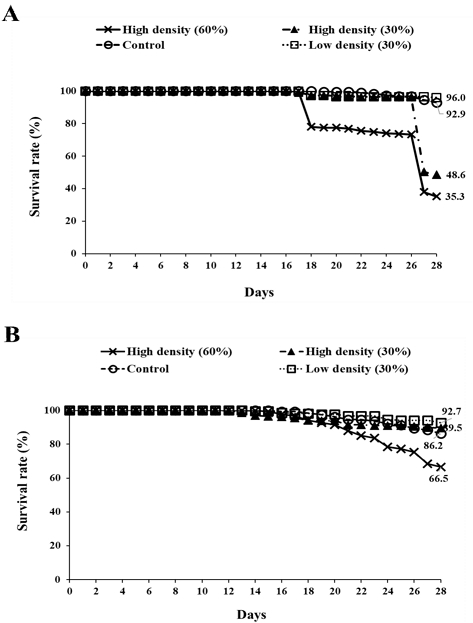
Survival rate of starry flounder by feeding and starvation conditions in high water temperature (28℃). A; feeding condition, B; starvation condition.
사료공급 및 비공급 시 비만도 K는 [Fig. 2]에 나타내었다. 사료 공급시 사료 섭취량은 고밀도 60% 그룹은 6.52 g/마리, 고밀도 30% 그룹은 8.68 g/마리 대조구는 8.94 g/마리, 저밀도 그룹은 8.25 g/마리를 나타냈다. 28℃에 노출된 이후 사료 섭취량은 급감하였으며 28℃에 노출된 5일 이후부터는 거의 사료를 섭취하지 않았다(data not shown). 고밀도 60% 그룹 1.53 ± 0.16, 고밀도 30% 그룹 1.54 ± 0.13, 대조구 1.76 ± 0.18, 저밀도 1.71 ± 0.17를 나타냈다([Fig. 2A]). 사료 비공급 시 고밀도 60% 그룹 1.42 ± 0.13, 고밀도 30% 그룹 1.54 ± 0.2, 대조구 1.66 ± 0.16, 저밀도 1.65 ± 0.14를 나타냈다([Fig. 2B]).
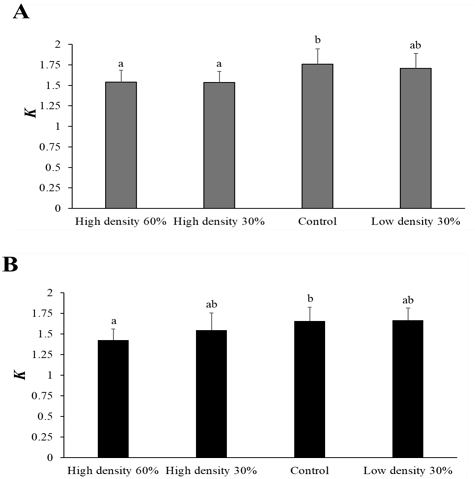
Effect of different stocking density on condition factor. A; feeding condition, B; starvation condition. Values are presented as the mean ± standard deviation (n = 9). Different letters indicate significant differences (p < 0.05).
체중 감소율은 사료 공급 시 고밀도 60% 그룹에서 -19.9 ± 3.18%, 고밀도 30% 그룹 -15.1 ± 6.82%, 대조구 -8.04 ± 2.54%, 저밀도 -8.0 ± 1.43%를 나타냈다([Fig. 3A]). 사료 비공급 시 고밀도 60% 그룹 -31.7 ± 12.4, 고밀도 30% 그룹 -20.9 ± 8.01, 대조구 -18.9 ± 6.17, 저밀도 -17.4 ± 1.84를 나타냈다([Fig. 3B]).
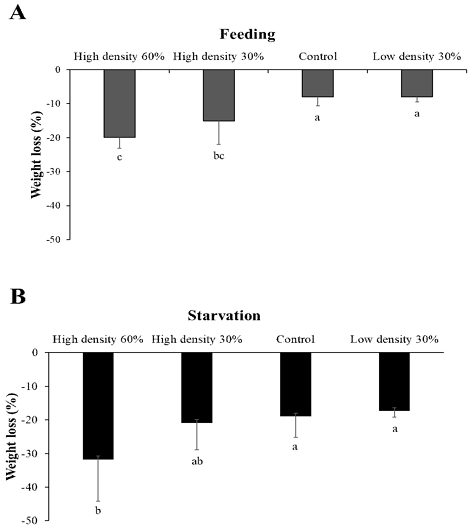
Weight loss (%) of starry flounder by feeding and starvation conditions. A; feeding condition, B; starvation condition. Values are presented as the mean ± standard deviation (n = 9). Each experiment was performed in triplicate. Different letters indicate significant differences (p < 0.05).
2. Plasma cortisol and glucose concentration
혈장 cortisol 및 glucose 농도는 [Fig. 4]에 나타내었다. Cortisol 농도는 사료공급구에서는 고밀도 60% 그룹에서 7일차에 8.60 ± 0.34 ng/mL로 가장 높게 나타났으며, 사료비공급구에서는 고밀도 30%에서 7일차에 8.65 ± 0.80 ng/mL로 가장 높게 나타났다([Fig. 4A, B]). 혈장 glucose농도는 사료공급구에서는 고밀도 60% 그룹에서 128.75 ± 39.91 mg/dL로 가장 높게 나타났으며, 사료비공급구에서는 개시 시에 86.00 ± 33.41 ng/mL로 가장 높게 나타난 이후 모든 실험구에서 감소하였으며 28일차 고밀도 60%에서 29.63 ± 63 mg/dL로 가장 낮게 나타났다([Fig. 4C, D]).
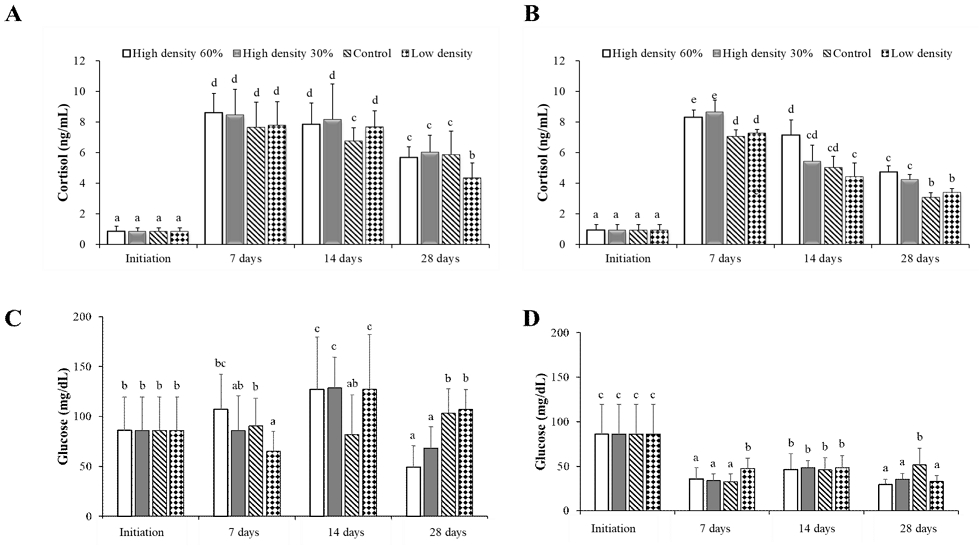
Plasma cortisol and glucose concentration of starry flounder by feeding and starvation conditions. A,C; feeding condition, B,D; starvation condition. Values are presented as the mean ± standard deviation (n = 9). Each experiment was performed in triplicate. Different letters indicate significant differences (p < 0.05).
3. Plasma biochemical concentration
혈장 AST 농도는 시간 경과에 따라 증가하였으며, 14일차부터 증가하여 28일차에 가장 높게 나타났다. 사료공급구는 28일차에 고밀도 60% 그룹에서 743.8 ± 320.57 U/L 가장 높았고, 사료비 공급구는 고밀도 30% 그룹에서 638 ± 338.7 U/L 가장 높게 나타났다. ALT 농도는 개시 시에 비해 혈장 내 유동성이 크게 나타났으며, 시간 경과나 밀도에 따른 경향성을 찾기는 어려웠다. TP는 28일차에 가장 낮은 농도를 나타내며 사료공급구에서 2.44 ± 0.31 mg/dL 가장 낮은 농도를 나타내었다. TCHO와 TG는 사료비공급구 28일차에 고밀도 60% 그룹에서 160.13 ± 37.73 mg/dL와 103.13 ± 39.55 mg/dL로 가장 낮은 농도를 나타냈다.
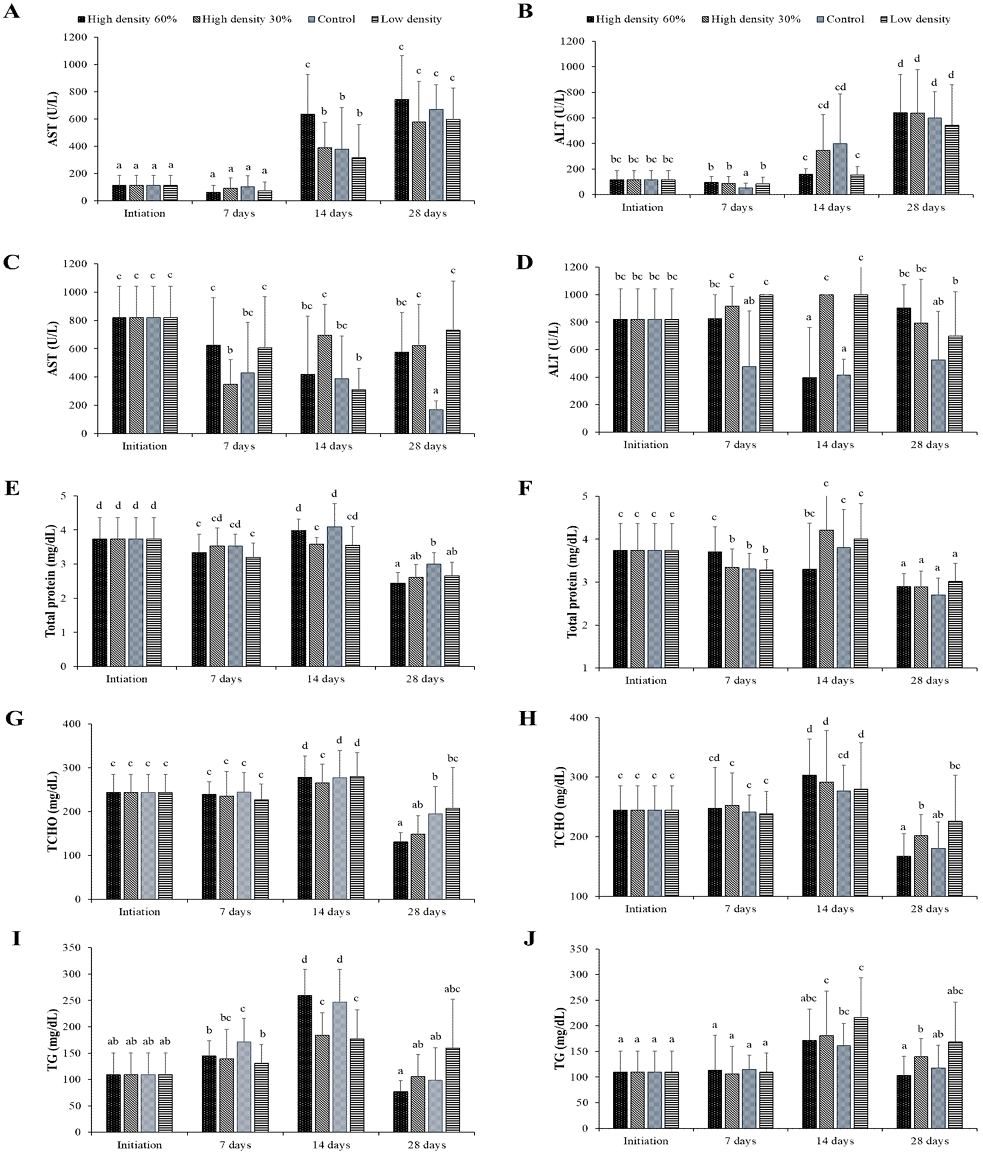
Plasma biochemical concentration of starry flounder by feeding and starvation conditions. A, C, E, G, I; feeding condition, B, D, F, H, J; starvation condition. Values are presented as the mean ± standard deviation (n = 9). Each experiment was performed in triplicate. Different letters indicate significant differences (p < 0.05). AST; aspartate aminotransferase, ALT; alanine aminotransferase TCHO; total cholesterol, TG: triglyceride.
4. Nutrients
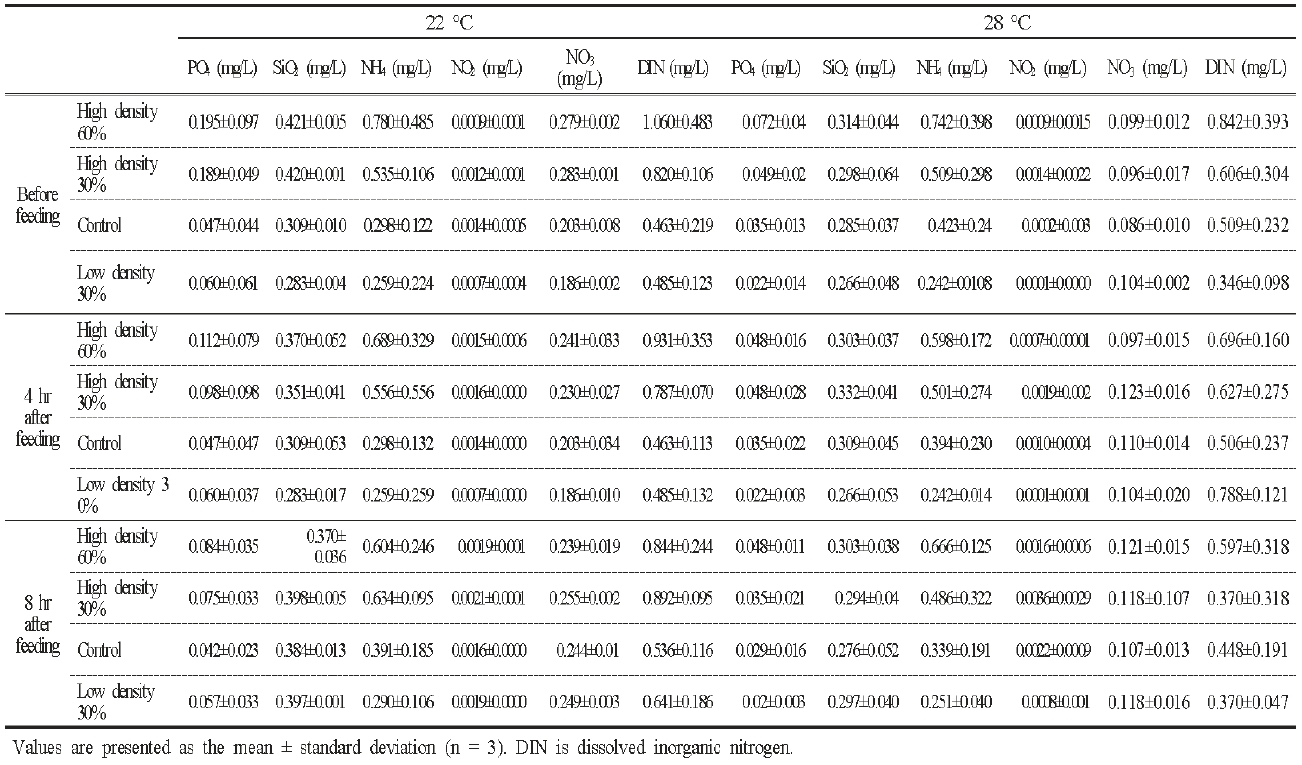
사육수에 용해되어 있는 영양염의 농도는 <Table 1>에 나타냈다. PO4와 SiO2의 농도는 22℃에서 28℃보다 높은 농도로 나타났고 밀도가 높을수록 높은 농도를 나타냈다. NH4와 NO3 농도는 22℃에서 더 높게 나타났으며, 밀도에 따라 높아지는 경향을 보였다. 따라서 Dissolved inorganic nitrogen (DIN) 농도 또한 22℃에서 밀도가 높을수록 높은 농도를 나타냈다. 시간별로는 사료를 주기 전에 가장 높은 PO4, SIO2, NH4, NO2 NO3 농도가 나타났다.

Changes in dissolved nutrients of sea water before and after feeding
Ⅳ. 결론 및 고찰
본 연구는 고수온기 사육밀도에 따른 강도다리의 생리학적 스트레스 반응을 조사하기 위한 목적으로 수행되었다.
사육밀도는 양식생물의 생존 및 생리적 반응에 영향을 미치며(Jia et al., 2016; Yarahmadi et al., 2016), 양식생물의 성장과 생산성에 영향을 미친다고 알려져 있다(Herrera et al., 2012; Menezes et al., 2015). 이전 연구에서는 고수온에 노출이 되면 생존율 감소, 성장 속도 저하, 단백질 합성 저해 등이 나타나며 반면 장기간의 절식은 체중 증가 지표에 부정적인 영향을 미친다(Jia et al., 2016; Refaey et al., 2018; Long et al., 2019; Manduca et al., 2021). 현재 연구에서 고수온기 고밀도 사육 시 생존율이 사육기간 경과에 따라 감소하였고, 특히 고밀도 60% 그룹에서 사료공급 시 35.2%로 매우 낮은 생존율을 나타냈으며, 사료비공급 시에도 다른 밀도에 비해 66.5%로 낮게 나타났다. 대조구와 저밀도에서는 생존율이 90% 이상으로 나타나 생존율 측면에서는 저밀도의 이점이 나타나지는 않았다. 고수온과 고밀도와 같은 스트레스 환경은 수생 생물의 사망, 질병, 성장 감소, 항상성 유지를 위한 과도한 내부 에너지 소비를 유발한다(Willmer et al., 2009).
고수온에서 사료공급 시 고밀도 60%는 6.52 g/마리로 가장 낮은 사료섭취량을 나타냈고 고밀도 30%, 대조구, 저밀도 30%는 86.5 g/마리, 8.94 g/마리, 8.25 g/마리로 나타나, 대조구에서 가장 높은 사료섭취량이 나타났다. 또한 28℃ 노출이 되면 사료섭취가 급격히 감소하며, 5일 이후부터는 사료섭취가 거의 없었다. 따라서 이러한 결과는 실험 종료 시 체중 변화와 생리학적 변화에 영향을 미칠 수 있다.
어류의 비만도(K)는 먹이 조건, 기생충 감염, 생리적 요인 간의 상호 작용을 통해 물리적 및 생물학적 환경과 유동적으로 나타난다(Le Cren, 1951). 비만도는 사료공급구에서 대조구와 고밀도 구간에서 유의적인 차이가 나타났지만 저밀도와는 유의 차가 없었다. 사료비공급구에서는 고밀도 60%와 대조구에서 유의차가 나타났으나 다른 실험구 간의 유의차는 나타나지 않았다. 따라서 비만도는 고밀도 사육보다는 적정 밀도를 유지할때 높게 나타났지만 사료공급과 비공급에서 가장 높은 비만도 값이 각각 1.76 ± 0.18과 1.66 ± 0.16으로 사료공급 유무에 따른 차이가 나타났다. 이전 연구에서 사료 공급 유무에 따른 비만도의 차이는 이전 연구에서도 보고되었으며, 비만도의 영향은 본 연구에서와 유사한 결과가 나타났다(Kim et al., 2021). 체중감소율 또한 고밀도 그룹에서 대조군과 저밀도 그룹보다 유의적으로 높게 나타났으며, 사료비공급시에 더 높은 체중감소를 나타냈다. 다른 연구들에서도 사육밀도가 성장에 부정적인 영향을 미치는 것으로 보고되었는데(Jia et al., 2016; Refaey et al., 2018; Long et al., 2019; Manduca et al., 2021), 본 연구에서도 강도다리가 높은 사육밀도에서는 성장에 부정적인 영향이 나타나는 것을 확인하였으며, 사료섭취량과 비만도, 체중감소를 고려하였을 때 강도다리 사육 시 적정 밀도를 유지하는 것이 필요하다.
Cortisol과 glucose는 어류와 같은 수산생물의 대표적인 스트레스 지표로 알려져 있다(Barton et al., 1986; Barton and Iwama, 1991). 간은 gluconeogenesis의 주요 기관이다(Samaras et al. 2018). 본 연구에서 강도다리의 혈장 cortisol 농도는 실험 개시시인 22℃에서 수온이 28℃로 상승한 7일차에 가장 높은 농도가 나타났다. 이후 시간 경과에 따라 감소하는 경향을 보였다. 많은 종에서 cortisol 농도의 변화는 열 스트레스 반응의 지표로 보고되었다. 대서양 대구(Gadus morhua), 금붕어(Carassius auratus), 제브라피시(Danio rerio), 무지개송어(Oncorhynchus mykiss)와 같은 어류에서는 수온 변화에 따라 cortisol 농도가 증가했다(Pérez-Casanov et al., 2008; Le Blanc et al., 2011; Yeh et al., 2013; Cockerm et al., 2019). Glucose는 cortisol과 달리 사료공급구에서는 유동성이 크게 나타났으나, 비공급구에서는 실험 개시기보다 감소하였다. 일반적으로 어류가 스트레스에 노출이 되면 혈액 내 catecholamine과 corticosteroid의 빠른 교환이 나타나 cortisol 농도를 증가시키며, 간에서 gluconeogenesis가 어려워지고 혈액 내 glucose 농도는 증가하는 것으로 알려져 있다(Cowey and Walton, 1989). 또한, 생물이 극심한 열 스트레스를 받으면 간은 gluconeogenesis을 수행할 수 없게 되어 간 내 glucose 농도가 감소한다(Cowey and Walton, 1989). 그러나 사료비공급구에서 glucose 농도가 감소한 것은 7일 샘플 기간 동안 스트레스에 노출 후 적응을 한 것으로 보여진다.
AST와 ALT는 간 기능 및 간 손상을 나타내는 대표적인 지표로 알려져 있으며, 주로 척추동물에서는 간세포에 존재하고 어류에서는 간과 비장 세포에 많이 분포하고 있다(Kang et al., 2007). AST와 ALT 같은 아미노기전이효소는 정상적인 상태에서는 세포 내에 존재하지만 스트레스 환경에 노출이 되면 세포 내의 효소를 방출하여 혈액 내 농도가 증가한다고 알려져 있다(Smith and Romas, 1980). 본 연구에서 AST는 사료공급구에서 14일차에 유의적인 차이를 보이며 증가하였으며 고밀도 60% 그룹에서 가장 높은 농도를 나타냈다. 사료 비공급구에서도 14일차에 증가하였지만 밀도 간의 경향성은 나타나지 않았다. ALT는 사료공급 및 비공급구에서 농도의 유동성이 커서 경향성을 찾기 어려웠다.
강도다리에서 ALT는 이전의 보고에서도 높은 유동성과 농도를 나타내어 스트레스 지표를 나타내기에는 어려움이 있다(Kim et al., 2021). 따라서, 연구의 결과를 종합하여 보면, 실험 종료시에 고밀도 그룹에서 가장 낮은 사육밀도가 나타났기 때문에 AST와 ALT 농도는 축적된 고수온 스트레스가 14일차 이후부터 급격하게 AST와 ALT의 농도를 증가시키는 것으로 보인다.
TP는 영양상태 및 환경적 스트레스에 반응하는 것으로 알려져 있으며(Chang and Hur, 1999), Byrne et al.(1989)의 보고에 의하면 경골어류에서 TP는 간 손상의 지표로 알려져 있다. 이전 연구에서, Micropterus dolomien는 절식 상태에서 일시적으로 혈장 TP 농도가 증가 하였고(Zolderdo et al., 2016), Salmo labrax는 급성 온도 스트레스에 노출 시 TP 농도가 증가 후 감소하여(Balta et al., 2017), 스트레스 환경에 노출이 될 때 TP 농도의 변화가 보고되었다. 본 연구에서 TP 농도는 시간 경과에 따라 감소하는 경향을 나타났는데 영양상태의 고갈과 스트레스에 저항 능력이 감소하여 TP 농도 감소에 영향을 주는 것으로 보인다. 급성 고수온에서는 에너지 요구량이 증가하고 지질 대사가 변한다(Peres et al., 2012). TCHO는 생체막의 중요한 구성 요소이며, 고온에서도 막의 유동성을 유지하여 생명 유지에 필수적이다(Peres et al., 2012). Hybrid yellow catfish를 35℃의 열 스트레스에 노출하였을 때 TCHO와 TG는 일시적으로 증가한 이후 시간 경과에 따라 감소를 했다(Zhang et al., 2020). 이것은 열적 스트레스에 대응하기 위하여 저장된 에너지를 동원하는 것으로, 어류는 스트레스 환경에 노출이 되면 에너지와 지질대사를 변화시켜 환경변화에 대응한다(Peres et al., 2012). 본 연구에서도 TCHO와 TG는 14일차까지 증가하였다가 28일차에는 감소를 하며, 유사한 경향을 나타낸다. 이것은 TP와 마찬가지로 영양상태의 고갈과 스트레스에 저항 능력이 감소로 여겨지며, 특히 28일차에 고밀도 60%에서 가장 낮은 농도를 나타내는데, 이때에는 높은 폐사로 인해 다른 실험구에 비해 낮은 밀도를 나타냄에도 불구하고, 고밀도와 고수온으로 인해 축적된 스트레스의 영향을 받은 것 또한 고려될 수 있다.
Nitrogen (N) 은 살아있는 모든 유기체에 필수적인 원소이다. 자연환경에서 N은 dinitrogen gas (N2), 암모늄(ammonium), 아질산염(nitrite), 질산염(nitrate), 유기물 등 다양한 농도와 형태로 물, 공기, 토양 사이를 활발하게 순환한다(Mandal and Shurin, 2018). 환경에서 이용할 수 있는 N은 NH4, NO2, NO3이며, 이들은 서식지에 따라 농도가 다르다. 해수에서 NO3의 농도는 7 ~ 31 µM이며 암모늄의 농도는 0.001 ~ 0.3 µM, NO2의 농도는 0.006 ~ 0.1 µM로 알려져 있다(Sanz-Luque, 2015). Kwon et al. (2019)에 따르면, 동해안 해역의 2013년부터 2017년까지 DIN의 농도는 0.0015 ~ 0.338 mg/L, PO4의 농도는 0.0139 ~ 0.0217 mg/L SiO2의 농도는 0.1798 ~ 0.4580 mg/L로 보고되었다. 해수의 영양염은 본 연구에서 생물에 유해하지 않은 NO3의 농도는 이전 연구에서 보고된 범위에 속하지만 아질산염과 NH4는 높은 농도를 나타냈다. 본연구에서는 순치 후 22℃에서 3일간, 수온을 1℃/일 상승시키며 28℃에 도달한 3일간 사육수의 영양염을 조사하였기에 전일 사료 섭취의 영향으로 사료공급 전 사육수의 NH4와 NO3의 농도가 높게 나타났다.또한 사료공급 8시간 후에도 자연해수보다 높은 농도의 PO4, SiO2, NH4, NO2, NO3가 나타나는 것은 계속해서 소화가 일어나고 배설물이 사육수에 녹아 있는 영향일 것이라 사료된다. 따라서 강도다리 양식 시 적정 밀도 유지 및 환수 등의 사육수 관리가 필요하다. 강도다리 국립수산과학원 「강도다리 양식기술 매뉴얼」에 따르면(NIFS, 2019), 사료 섭취 후 배설량을 조사한 결과, 수온 10, 15, 20℃에서 33.0, 43.4, 55.3 mg TAN/kg fish/h로 수온일 높을수록 총 배설량이 높다고 보고되었다. 본 연구에서 22℃에서 28℃보다 PO4, SiO2, NH4, NO2, NO3 농도가 높게 나타났는데 이것을 먹이 섭취량이 28℃에서 감소하였기 때문으로(data not shown) 사료섭취에서 기인하는 것으로 사료된다. 또한 사육밀도가 높을수록 높은 농도를 나타내었는데 이러한 결과는 사료 섭취량 증가와 배설 때문으로 여겨진다. NO2의 경우 수온에 따른 차이가 없었으나, NO3의 경우 이 연구에서 보고된 것과 같이 낮은 수온에서 높게 나타났다(Silió-Calzadan et al., 2008).
결론적으로 고수온기 사육밀도에 따른 생존율, 성장 및 스트레스 지표들을 종합해 보면 강도다리는 고밀도 사육 시 생존율이 낮았으며, 비만도가 낮고 체중감소가 더 높았다. 고수온기에 고밀도 사육 시 저밀도 또는 적정 밀도 유지보다 스트레스 지표가 높으므로 고밀도 사육이 경제적인 측면에서 부정적이며, 강도다리 사육 시에 적정 밀도 유지가 필요할 것으로 보인다. 따라서 본 연구 결과는 고수온기 사육밀도 영향에 따른 강도다리의 생리적 반응 및 스트레스를 이해하는데 기초 자료로 활용될 것이라 기대한다
Acknowledgments
이 논문은 2026년도 국립수산과학원 수산과학연구사업 주요 양식품종 모니터링(R2026045)의 지원으로 수행된 연구입니다..
References
-
Ahmad T, Singh SP, Khangembam BK, Sharma JG and Chakrabarti R(2014). Food consumption and digestive enzyme activity of Clarias batrachus exposed to various temperatures. Aquac Nutrition, 20, 265~272.
[https://doi.org/10.1111/anu.12072]

-
Ainsworth AJ, Dexiang C, Waterstrat P and Greenway T(1991). Effect of temperature on the immune system of channel catfish (Ictalurus punctatus). Leucocyte distribution and phagocyte function in the anterior kidney at 10 ℃. Comp Biochem Physiol Part A: Physiol, 100(4), 907~912.
[https://doi.org/10.1016/0300-9629(91)90313-2]
-
Balta ZD, Akhan S and Balta F(2017). The physiological stress response to acute thermal exposure in Black Sea trout (Salmo trutta labrax Pallas, 1814). Turkish Journal of Veterinary & Animal Sciences, 41, 400~406.
[https://doi.org/10.3906/vet-1606-32]
-
Barton BA and Iwama GK(1991). Physiological changes in fish from stress in aquaculture with emphasis on the response and effects of corticosteroids. Annu Rev Fish Dis, 1, 3~26.
[https://doi.org/10.1016/0959-8030(91)90019-G]
-
Barton BA, Schreck CB and Sigismondi LA(1986). Multiple acute disturbances evoke cumulative physiological stress responses in juvenile Chinook salmon. Trans Am Fish Socience, 115, 245~251.
[https://doi.org/10.1577/1548-8659(1986)115<245:MADECP>2.0.CO;2]
-
Besson M, Vandeputte M, van Arendonk JAM, Aubin J, de Boer IJM, Quillet E and Komen H(2016). Influence of water temperature on the economic value of growth rate in fish farming: the case of sea bass (Dicentrarchus labrax) cage farming in the Mediterranean. Aquaculture, 462, 47~55.
[https://doi.org/10.1016/j.aquaculture.2016.04.030]
- Chang YJ and Hur JW(1999). Physiological responses of grey mullet, Mugil cephalus and Nile tilapia Oreochromis niloticus by rapid changes in salinity of rearing water. Fish Aquat Sciences, 32, 310~316.
-
Clark BJ, Wells J, King SR and Stocco DM(1994). The purification, cloning, and expression of a novel luteinizing hormone-induced mitochondrial protein in MA-10 mouse Leydig tumor cells. Characterization of the steroidogenic acute regulatory protein (StAR). Journal of Biology Chemistry, 269(45), 28314~28322.
[https://doi.org/10.1016/S0021-9258(18)46930-X]
-
Cockrem JF, Bahry MA, Chowdhury VS(2019). Cortisol responses of goldfish (Carassius auratus) to air exposure, chasing, and increased water temperature. Gen Comp Endocrinol, 270, 18~25.
[https://doi.org/10.1016/j.ygcen.2018.09.017]
- Cowey CB and Walton MJ(1989). Intermediary metabolism. In: Fish Nutrition, 2nd ed. Halver JE, Ed. Academic Press, New York, NY, USA, 259~329.
-
Davis KB and Parker NC(1990). Physiological stress in striped bass: Effect of acclimation temperature. Aquaculture, 91(3-4), 349~358.
[https://doi.org/10.1016/0044-8486(90)90199-W]
- De Silva SS and Soto D(2009). Climate change and aquaculture: Potential impacts, adaptation and mitigation. In Climate Change Implications for Fisheries and Aquaculture: Overview of Current Scientific Knowledge Cochrane K, De Young C, Soto D and Bahri T Eds FAO Fisheries Technical Paper, 530, 151~212.
-
Guillen AC, Borges ME, Herrerias T, Kandalski PK, Marins EA, Viana D, Souza MRDP, Daloski LOC and Donatti L(2019). Effect of gradual temperature increase on the carbohydrate energy metabolism responses of the Antarctic fish Notothenia rossii. Marine Environmental Research, 150, 104779.
[https://doi.org/10.1016/j.marenvres.2019.104779]
-
Herrera M, Ruiz-Jarabo I, Hachero I, Vargas-Chacoff L, Amo A and Mancera JM(2012). Stocking density affects growth and metabolic parameters in the brill (Scophthalmus rhombus). Aquacult Int, 20, 1041~1052.
[https://doi.org/10.1007/s10499-012-9513-9]
-
Htun-Han M(1978). The reproductive biology of the dab Limanda limanada (L.) in the North Sea: Gonadosomatic index, hepatosomatic index and condition factor. Journal of Fish Biology, 13(3), 369~378.
[https://doi.org/10.1111/j.1095-8649.1978.tb03445.x]
-
Irwin S, O’Halloran J and Fitzgerald R(1999). Stocking density, growth and growth variation in juvenile turbot, Scophthalmus maximus (Rafinesque). Aquaculture, 178, 77~88.
[https://doi.org/10.1016/S0044-8486(99)00122-2]
-
Jia R, Liu BL, Feng WR, Han C, Huang B and Lei JL(2016). Stress and immune responses in skin of turbot (Scophthalmus maximus) under different stocking densities. Fish Shellfish Immunol, 55, 131~139.
[https://doi.org/10.1016/j.fsi.2016.05.032]
-
Kang DY, Kang HW, Kim GH, Jo KC and Kim HC(2007). Effect of cold shock on the physiological response of the cultured mullet, Mugil haematocheilus in winter. Korean Journal of Fish Sciences, 40, 226~233.
[https://doi.org/10.5657/kfas.2007.40.4.226]
-
Kim SS, Han GS, Yoo HK, Kim KT, Byun SG, Jung MM, Kim WJ and Hwang SD(2021). Effect of Temperature Fluctuation and Nutritional Status on Starry Flounder, Platichthys stellatus, Survival and Adaptive Physiological Response. Journal of Marine Science and Engineering, 9(12), 1361.
[https://doi.org/10.3390/jmse9121361]
-
Kim SS, Lee JH, Kim KW, Kim KD, Lee BJ and Lee KJ(2015). Effects of feed particle size, stocking density, and dissolved oxygen concentration on the growth of olive flounder Paralichthys olivaceus. Korean Journal of Fish Aquatic Sciences, 48, 314~321.
[https://doi.org/10.5657/KFAS.2015.0314]
- KOSIS(2026). Available online at: http://www.kosis.kr
-
Kwon KY, Shim JH and Shim JM(2019). Temporal variations of sea water environment and nutrients in the east coast of Korea in 2013~2017: Sokcho, Jukbyeon and Gampo Coastal areas. J. Korean Soc. Mar. Environ. & safety, 25(4), 457~467.
[https://doi.org/10.7837/kosomes.2019.25.4.457]
-
Le Cren ED(1951). The length-weight relationships and seasonal cycle in gonad weight and condition in the perch (Perca fluviatilis). Journal, Anim Ecology, 20, 201~219.
[https://doi.org/10.2307/1540]
-
LeBlanc S, Middleton S, Gilmour KM and Currie S(2011). Chronic social stress impairs thermal tolerance in the rainbow trout (Oncorhynchus mykiss). Journal of Exp Biology, 214, 1721~1731.
[https://doi.org/10.1242/jeb.056135]
-
Lee S, Park JW, Jeong M, Jung HS, Kim J, Kim WJ, Lee JH and Lee D(2023). Effects of rearing density stress on malformation and stress and immune related gene expression of juvenile olive flounder Paralichthys olivaceus. Korean Journal of Fish Aquat Sciences, 56(4), 380~387.
[https://doi.org/10.5657/KFAS.2023.0380]
- Lim HK, Byun SG, Lee JH, Park SU, Kim YC, Han HK, Min BH and Lee BY(2007). Sexual maturity and reproductive cycle of starry flounder Platichthys stellatus cultured in indoor tank. Journal of Aquac, 20, 212~218.
-
Long L, Zhang H, Ni Q, Liu H, Wu F and Wang X(2019). Effects of stocking density on growth, stress, and immune responses of juvenile Chinese sturgeon (Acipenser sinensis) in a recirculating aquaculture system. Comp Biochem Physiol C Toxicol Pharmacol, 219, 25~34.
[https://doi.org/10.1016/j.cbpc.2019.02.002]
-
Mandal S, Shurin JB, Efroymson RA and Mathews TJ(2018). Functional divergence in nitrogen uptake rates explains diversity-productivity relationship in microalgal communities. Ecosphere, 9, e02228.
[https://doi.org/10.1002/ecs2.2228]
-
Manduca LG, da Silva MA, de Alvarenga ÉR, de Oliveira Alves GF, Ferreira NH, de Alencar Teixeira E, Fernandes AFA, de Almeida e Silva M and Turra EM(2021). Effects of different stocking densities on nile tilapia performance and profitability of a biofloc system with a minimum water exchange. Aquaculture, 530, 735814.
[https://doi.org/10.1016/j.aquaculture.2020.735814]
-
Menezes C, Ruiz-Jarabo I, Martos-Sitcha JA, Toni C, Salbego I and Becker A(2015). The influence of stocking density and food deprivation in silver catfish (Rhamdia quelen): A metabolic and endocrine approach. Aquaculture, 435, 257~264.
[https://doi.org/10.1016/j.aquaculture.2014.09.044]
-
Min BH, Park MS, Shin YK, Do YH and Myeong JI(2014). Physiological responses in Korean rockfish (Sebastes schlegeli) exposed to ammonia. Korean Journal of Environ Biology, 32(4), 344~352.
[https://doi.org/10.11626/KJEB.2014.32.4.344]
- NIFS (National Fisheries Research and Development Institute)(2019). Technical Manual for the Starry flounder Aquaculture. East Sea Fish Res Inst, Uljin, Korea, 131.
- NIFS (National Fisheries Research and Development Institute)(2026). Tips farm management during warm water season, 3.
-
Pacheco M and Santos MA(2001). Biotransformation, endocrine, and genetic responses of Anguilla anguilla L. to petroleum distillate products and environmentally contaminated waters. Ecotoxicol Environ Saf, 49, 64~75.
[https://doi.org/10.1006/eesa.2000.2025]
-
Peres H, Santos S and Oliva-Teles A(2012). Selected plasma biochemistry parameters in gilthead seabream (Sparus aurata) juveniles. Journal of Applied Ichthyol, 29, 630~636.
[https://doi.org/10.1111/j.1439-0426.2012.02049.x]
-
Pérez-Casanova JC, Afonso LOB, Johnson SC, Currie S and Gamperl AK(2008). The stress and metabolic responses of juvenile Atlantic cod Gadus morhua L. to an acute thermal challenge. Journal of Fish Biology, 72, 899~916.
[https://doi.org/10.1111/j.1095-8649.2007.01763.x]
-
Refaey MM, Li D, Tian X, Zhang Z, Zhang X, Li L and Tang R(2018). High stocking density alters growth performance, blood biochemistry, intestinal histology, and muscle quality of channel catfish Ictalurus punctatus. Aquaculture, 492, 73~81.
[https://doi.org/10.1016/j.aquaculture.2018.04.003]
-
Samaras A, Papandroulakis N, Lika K and Pavlidis M(2018). Water temperature modifies the acute stress response of European sea bass, Dicentrarchus labrax L. (1758). Journal of Therm Biology, 78, 84~91.
[https://doi.org/10.1016/j.jtherbio.2018.09.006]
-
Sanz-Luque E, Chamizo-Ampudia A, Llamas A, Galvan A and Fernandez E(2015). Understanding nitrate assimilation and its regulation in microalgae. Front Plant Sciences, 6, 899.
[https://doi.org/10.3389/fpls.2015.00899]
-
Servili A, Canario AVM, Mouchel O and Muñoz-Cueto JA(2020). Climate change impacts on fish reproduction are mediated at multiple levels of the brain-pituitary-gonad axis. Gen Comp Endocrinol, 291, 113439.
[https://doi.org/10.1016/j.ygcen.2020.113439]
-
Silió-Calzada A, Bricaud A and Gentili B(2008). Estimates of sea surface nitrate concentrations from sea surface temperature and chlorophyll concentration in upwelling areas: A case study for the Benguela system. Remote Sens Environ, 112(6), 3173~3180.
[https://doi.org/10.1016/j.rse.2008.03.014]
-
Smith AC and Ramos F(1980). Automated chemical analysis in fish health assessment. Journal of Fish Biology, 17(4), 445~450.
[https://doi.org/10.1111/j.1095-8649.1980.tb02777.x]
- Wang YJ, Wu Z, Sheng XM and Tang HF(2005). Effect of beta-cypermethrin on GPT and GOT activities of crucian serum. Agr Sciences Technology, 6, 20~23.
- Willmer P, Stone G and Johnston I(2009). Environmental Physiology of Animals. Wiley-Blackwell: Malden, MA, USA, 784.
-
Yarahmadi P, Miandare HK, Hoseinifar SH, Gheysvandi N and Akbarzadeh A(2014). The effects of stocking density on hemato-immunological and serum biochemical parameters of rainbow trout (Oncorhynchus mykiss). Aquac Int, 23, 55~63.
[https://doi.org/10.1007/s10499-014-9797-z]
-
Yeh CM, Glöck M and Ryu S(2013). An Optimized Whole-Body Cortisol Quantification Method for Assessing Stress Levels in Larval Zebrafish. PLoS ONE 8, e79406.
[https://doi.org/10.1371/journal.pone.0079406]
-
Zhang L, Qiang J, Tao YF, Bao JW, Zhu HJ, He J and Xu P(2020). Cloning of the gene encoding acyl-CoA thioesterase 11 and its functional characterization in hybrid yellow catfish (Pelteobagrus fulvidraco ♀ × Pelteobagrus vachelli ♂) under heat stress. Journal of Therm Biology, 93, 102681.
[https://doi.org/10.1016/j.jtherbio.2020.102681]
-
Zolderdo AJ, Algera DA, Lawrence MJ, Gilmour KM, Fast MD, Thuswaldner J, Willmore WG and Cooke SJ(2016). Stress, nutrition and parental care in a teleost fish: exploring mechanisms with supplemental feeding and cortisol manipulation. Journal of Exp Biology, 219, 1237~1248.
[https://doi.org/10.1242/jeb.135798]